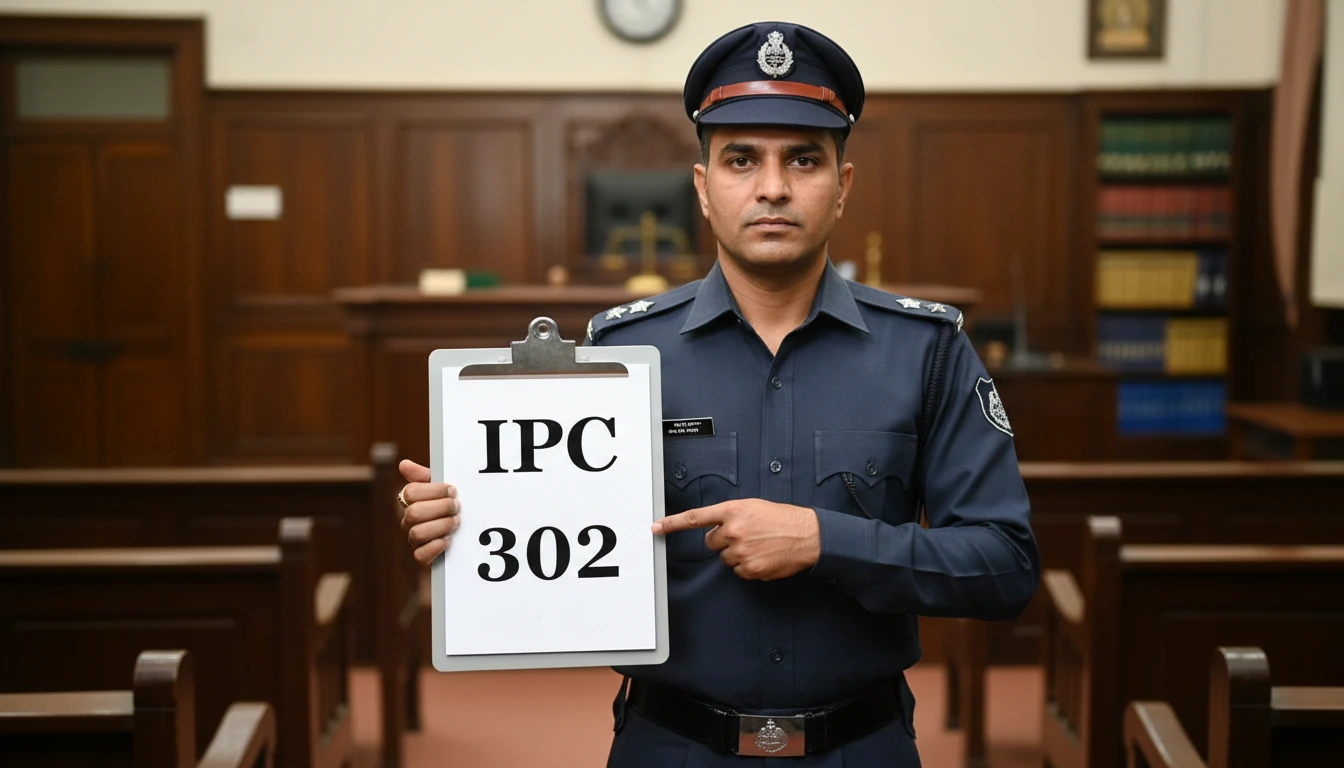
IPC 302 defines punishment for murder under Indian law. It provides death or life imprisonment with possible fine. Many people fear the harshest outcome without understanding legal safeguards. I understand how confusing this can be during crisis moments. At Lawwalls, I explain IPC 302 clearly and practically. You will learn how courts decide guilt, sentence, bail, and appeals. I have reviewed hundreds of criminal files across Indian cities. This guide offers clarity, strategy, and reassurance when stakes feel overwhelming.


Lawwalls
Get realtime updates and indepth insights? Follow our WhatsApp channel to receive instant notifications and stay informed.
FollowElements of Murder Under Section 300
To understand IPC 302, we must first examine section 300. Section 300 defines when culpable homicide becomes murder legally. Courts analyse intention, knowledge, and surrounding circumstances carefully. Lawyers call this mental element men’s rea requirement. The physical act causing death forms actus reus element. Both elements must exist beyond reasonable doubt. Judges also examine medical evidence and eyewitness credibility closely. Without these essentials, prosecution struggles to secure conviction.
Section 300 also lists exceptions reducing liability significantly. Sudden provocation may convert murder into lesser offence. Private defence exceeding limits can alter legal outcome. Insanity defence may remove criminal responsibility entirely. These nuances often decide between section 302 and section 304. I have seen trials hinge on single medical opinion. Understanding these exceptions provides realistic hope during defense. Clarity about these distinctions prevents dangerous assumptions about automatic punishment.
Punishment Under Section 302 and Sentencing Principles
Section 302 states punishment is death or life imprisonment. Courts do not impose death mechanically in every conviction. The Supreme Court created rarest of rare doctrine. Judges balance aggravating factors against mitigating circumstances carefully. Aggravating factors include brutality, premeditation, or societal shock. Mitigating circumstances include age, background, and reform possibility. This structured sentencing ensures fairness within severe framework.
Life imprisonment under Indian law means natural life. However remission policies sometimes reduce actual years served. State governments consider remission through administrative review processes. Parole allows temporary release under strict conditions. Commutation may convert death penalty into life imprisonment. Sentencing guidelines require separate pre sentence hearing. Defence presents mitigation materials during that stage. Effective advocacy here can change entire future trajectory.
Difference Between Section 302 and Section 304
Many readers confuse murder with culpable homicide. Section 304 covers culpable homicide not amounting to murder. The distinction rests on degree of intention and knowledge. Murder involves clear intention to cause death. Section 304 applies when intention is less direct. Punishment under section 304 is comparatively lighter. Courts carefully analyse medical evidence and witness testimony. This difference often determines sentencing range dramatically.
In practical courtroom situations, facts matter immensely. A sudden fight without premeditation may attract section 304. Excessive self defence may also reduce liability. Defence lawyers focus on intent and circumstances carefully. Prosecution attempts proving deliberate and calculated conduct instead. I have observed appellate courts modifying convictions frequently. Understanding this distinction empowers families facing serious allegations. Legal strategy begins with correct classification analysis.
Is IPC 302 a Non Bailable Offence
Murder is categorized as non bailable offence. Police register investigation and file charge sheet promptly. Trial occurs before Sessions Court in major cities. Bail in murder case requires strong legal grounds. High Court may grant bail in exceptional circumstances. Courts consider evidence strength and investigation stage carefully. Lengthy custody without trial can influence judicial discretion.
In New Delhi, Mumbai, and Kolkata, procedures remain similar. Accused must present medical grounds or evidentiary weaknesses. Bengaluru and Chennai courts follow comparable principles. District Legal Services Authority may assist eligible defendants. Strategic representation during early hearings proves critical. Judges evaluate risk of tampering with evidence. Each bail decision reflects balance between liberty and justice.
Juveniles and Special Considerations in Murder Cases
Juvenile justice law treats minors differently from adults. If accused was under eighteen during incident, procedure changes. Death penalty cannot be imposed on juveniles. Special boards assess maturity and circumstances thoroughly. Some serious cases may transfer to regular court. Even then sentencing follows protective statutory framework. Rehabilitation remains central objective under juvenile justice system.
Families often misunderstand these protective provisions completely. I explain that age determination becomes crucial issue. Documentary proof and medical examination establish age conclusively. Courts ensure constitutional safeguards remain intact always. Even in grave offences, reform possibility matters legally. This humane approach reflects evolving criminal jurisprudence principles. Awareness of these safeguards reduces unnecessary panic.
Trial Procedure Evidence and Appeals
Murder trials demand proof beyond reasonable doubt. Prosecution relies on forensic evidence and witness accounts. Circumstantial evidence must form complete chain logically. Defence challenges inconsistencies and procedural lapses strategically. Section 34 may apply for common intention cases. Trial procedure includes examination, cross examination, and final arguments. Sessions Court pronounces conviction and sentence separately.
After conviction, criminal appeal lies before High Court. Further appeal may reach Supreme Court jurisdiction. Death sentences require confirmation by High Court compulsorily. Clemency petitions may be submitted to authorities. Appellate courts reassess evidence and sentencing factors independently. I have seen convictions overturned due to evidentiary gaps. Appeals provide meaningful safeguard against miscarriage of justice.
Mitigation Strategy and Pre Sentence Advocacy
Pre sentence hearing offers powerful opportunity for defence. Lawyers present mitigation materials regarding background and character. Evidence of reform potential influences judicial discretion. Family dependency and lack of prior record matter. Psychological evaluations sometimes support compassionate sentencing. Detailed mitigation notes humanize accused before court.
I always advise preparing structured mitigation documentation early. Judges respond to authentic narratives supported by evidence. Sentencing is not purely mechanical mathematical exercise. Emotional intelligence and legal precision work together. Balanced advocacy respects victim perspective while seeking fairness. Thoughtful preparation can prevent irreversible consequences.
Conclusion
IPC 302 carries the gravest consequences under Indian criminal law. Yet safeguards, appeals, and structured sentencing principles protect fairness. I understand the fear surrounding murder allegations deeply. Clear knowledge about section 300, section 304, and mitigation helps enormously. At Lawwalls, we believe informed citizens make stronger decisions. Whether you face investigation in Mumbai or New Delhi, strategic guidance matters. Understanding IPC 302 empowers you to respond calmly and confidently within lawful framework.
If you want to learn about section IPC 420, I have written a comprehensive guide on Lawwalls explaining cheating offences, punishment, evidence, FIR process, defences, civil versus criminal differences, and practical steps for victims and accused across cities like Delhi, Mumbai, Bengaluru, Chennai, and Kolkata.
<?php


/**
 * Auto Table of Contents - WordPress Code Snippet
 * Shortcode: [auto_toc]
 * Headings: H2, H3, H4
 * Style: Grey Card (same as design)
 */

function auto_toc_shortcode() {
    global $post;
    if ( ! $post ) return '';

    $content = $post->post_content;

    // H2, H3, H4 extract karo
    preg_match_all( '/<h([234])[^>]*>(.*?)<\/h\1>/is', $content, $matches );

    if ( empty( $matches[0] ) ) return '';

    $items = '';
    $counter = 1;

    foreach ( $matches[2] as $index => $heading_text ) {
        $level     = $matches[1][ $index ];
        $clean     = wp_strip_all_tags( $heading_text );
        $anchor_id = 'toc-heading-' . $counter;

        // Indentation for H3, H4
        $indent = '';
        if ( $level == 3 ) {
            $indent = 'padding-left:16px;';
        } elseif ( $level == 4 ) {
            $indent = 'padding-left:32px;';
        }

        $items .= '<li style="' . $indent . '"><a href="#' . esc_attr( $anchor_id ) . '" style="color:inherit;text-decoration:none;">' . esc_html( $clean ) . '</a></li>';
        $counter++;
    }

    // TOC Card HTML + CSS + JS
    $html = '
<style>
.auto-toc-box{background-color:#F0F1F5;border:1px solid #D4D4D4;padding:16px 20px;border-radius:14px;font-family:\'Poppins\',-apple-system,BlinkMacSystemFont,\'Segoe UI\',sans-serif;width:100%;box-sizing:border-box;margin:20px 0;}
.auto-toc-row{display:flex;align-items:center;justify-content:space-between;gap:12px;}
.auto-toc-title{margin:0;font-size:1rem;font-weight:600;color:#000;flex:1;}
.auto-toc-btn{background:rgba(0,0,0,0.04);border:none;font-size:1.1rem;font-weight:600;cursor:pointer;width:32px;height:32px;border-radius:50%;display:inline-flex;align-items:center;justify-content:center;color:#000;font-family:inherit;}
.auto-toc-btn:hover{background:rgba(0,0,0,0.08);}
.auto-toc-body{display:none;margin-top:12px;padding-top:12px;border-top:1px dashed rgba(0,0,0,0.15);}
.auto-toc-body ol{margin:0;padding-left:20px;font-size:0.88rem;color:#111;line-height:2.1;font-family:inherit;}
.auto-toc-body ol li a:hover{text-decoration:underline;}
</style>

<div class="auto-toc-box">
  <div class="auto-toc-row">
    <h2 class="auto-toc-title">Table of Contents</h2>
    <button class="auto-toc-btn" onclick="(function(btn){var b=btn.closest(\'.auto-toc-box\').querySelector(\'.auto-toc-body\');var open=b.style.display===\'block\';b.style.display=open?\'none\':\'block\';btn.textContent=open?\'+\':\'×\';})(this)">+</button>
  </div>
  <div class="auto-toc-body">
    <ol>' . $items . '</ol>
  </div>
</div>';

    return $html;
}
add_shortcode( 'auto_toc', 'auto_toc_shortcode' );


/**
 * Article ki headings mein auto anchor IDs add karo
 * Taake TOC ke links kaam karein
 */
function auto_toc_add_anchors( $content ) {
    $counter = 1;
    $content = preg_replace_callback(
        '/<h([234])([^>]*)>(.*?)<\/h\1>/is',
        function( $matches ) use ( &$counter ) {
            $level   = $matches[1];
            $attrs   = $matches[2];
            $text    = $matches[3];
            $anchor  = 'toc-heading-' . $counter;
            $counter++;
            return '<h' . $level . $attrs . ' id="' . esc_attr( $anchor ) . '">' . $text . '</h' . $level . '>';
        },
        $content
    );
    return $content;
}
add_filter( 'the_content', 'auto_toc_add_anchors' );
Frequently Asked Questions About IPC 302
What does IPC 302 state about punishment?
IPC 302 states that whoever commits murder shall face death or life imprisonment and fine. Courts apply sentencing after full trial and separate hearing on mitigating and aggravating circumstances.
When is death penalty awarded under section 302?
Death penalty is imposed only in rarest of rare cases. Courts balance brutality, motive, and reform possibility before deciding. Most convictions result in life imprisonment rather than capital punishment.
How is section 302 different from section 304?
Section 302 covers murder with clear intention to kill. Section 304 applies when intention is weaker or circumstances reduce culpability. Punishment under section 304 is comparatively less severe.
Is IPC 302 bailable in India?
IPC 302 is generally non bailable due to seriousness. However High Court or Sessions Court may grant bail depending on evidence, investigation stage, and specific facts presented before court.
What does life imprisonment actually mean?
Life imprisonment legally means imprisonment for remainder of natural life. Remission policies may reduce actual time served, but release is never automatic and depends on government evaluation procedures.
Can a juvenile receive death sentence for murder?
A juvenile cannot receive death sentence under Indian law. Special juvenile justice procedures apply, focusing on rehabilitation and age assessment before determining appropriate legal consequences.
Which court tries offences under section 302?
Offences under section 302 are tried by Sessions Court. Appeals from conviction lie before High Court and sometimes Supreme Court depending on legal grounds and constitutional questions involved.
What evidence is needed to prove murder?
Prosecution must prove intention, causation, and death beyond reasonable doubt. Forensic reports, eyewitness testimony, and circumstantial evidence must form consistent chain pointing clearly toward guilt.
Can conviction under section 302 be reduced on appeal?
Yes appellate courts can alter conviction to section 304. If evidence shows absence of clear intention or presence of exceptions, sentence may be reduced accordingly.
What immediate steps should someone take if charged?
Seek experienced criminal lawyer immediately and avoid self incrimination. Preserve documents and cooperate lawfully while preparing strong defence strategy focused on evidence and procedural safeguards.