

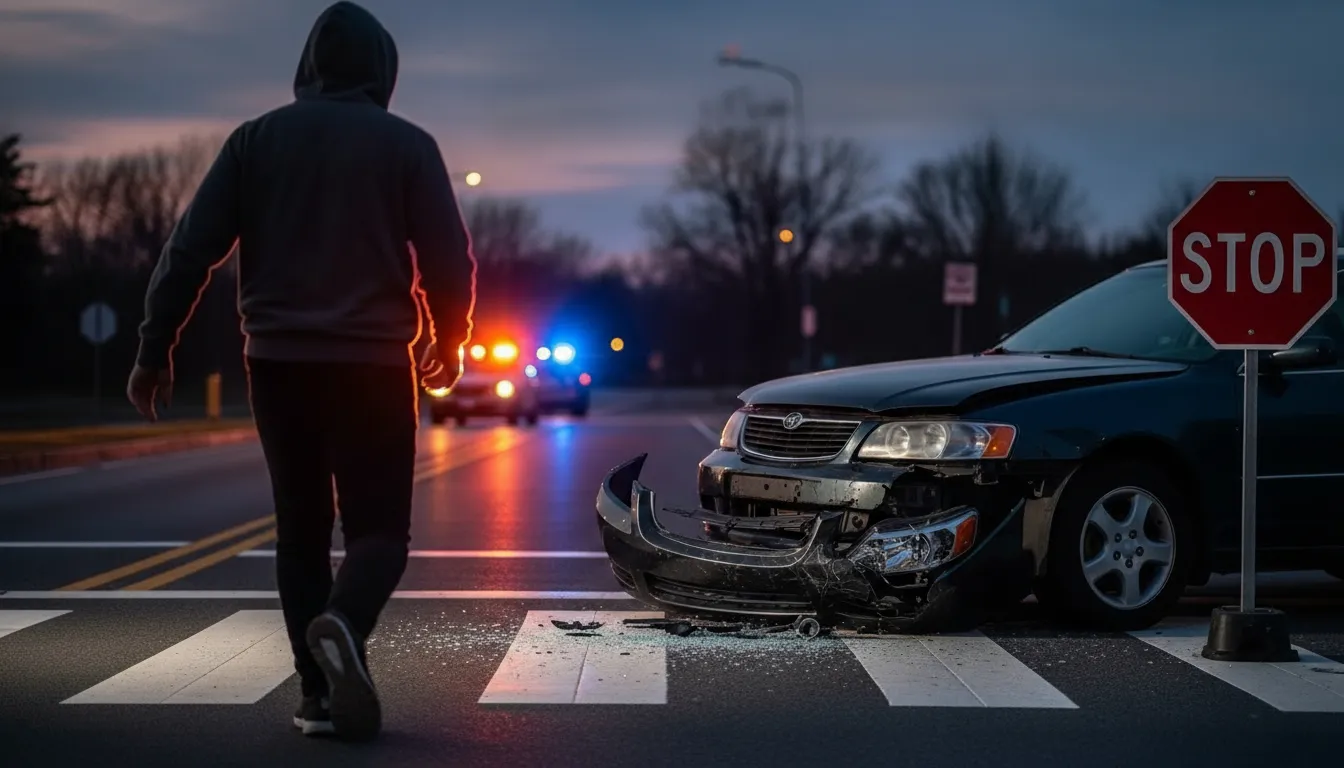
The new hit-and-run law in India is Section 106 of the Bharatiya Nyaya Sanhita (BNS) 2023, which replaced the old Indian Penal Code and came into effect on July 1, 2024. For millions of Indian drivers, this law means the decision you make in the sixty seconds after a road accident can shape the next decade of your life. The BNS introduced a two-tier penalty system that separates drivers who stay and report from drivers who flee. This complete guide covers what the law actually says, what’s changed in 2026, and exactly what you need to know.
What the Old Hit and Run Law Got Completely Wrong
Here’s the thing most people don’t realize: India’s old hit-and-run law dated back 160 years and it treated staying and fleeing as the same moral act. Under Section 304A of the Indian Penal Code, causing death by reckless driving carried a maximum sentence of just two years. Whether you stopped to call an ambulance or vanished into the night, the legal outcome was identical. That made no sense in a country with some of the most dangerous roads on the planet, and legislators knew it was long overdue for a change.
The numbers behind this reform are impossible to ignore. Official records compiled by the National Crime Records Bureau show 47,806 hit-and-run incidents in India in 2022, which resulted in the deaths of 50,815 people. That’s roughly 140 lives lost every single day in accidents where drivers chose to run. These aren’t abstract statistics. Every number in that count is a family that waited at a roadside while help never came. That data made it impossible for policymakers to delay an overhaul any further.
Beyond the statistics, the cases that drove this reform were impossible to ignore. High-profile incidents across India’s major cities showed a consistent pattern: drivers fled fatal accidents in the early hours, victims went without help during critical time windows, and prosecutors struggled to secure meaningful sentences under a law that maxed out at two years. The 2023 case in Delhi, where a young woman was dragged beneath a car for several kilometers, became a national reckoning. It crystallized what the data had been showing for years: the old law was giving drivers a reason to run.
What Changed: Old Hit and Run Law vs New BNS Provisions
This is where most guides lose the plot. The BNS didn’t simply increase the punishment. It introduced a fundamentally different legal philosophy. For the first time, Indian law recognized the act of fleeing as a separate and more serious offence than the accident itself. The colonial-era IPC had one flat consequence for everyone involved in a deadly road accident. The BNS created two distinct paths, each designed to reflect the moral choice a driver makes immediately after causing harm.
Here’s something worth understanding before you look at the numbers. The shift from old to new law changed multiple layers at once: the punishment, the bail eligibility, the fine structure, and the legal classification of the offence. That means the full weight of the change isn’t visible in any single figure. You don’t just face a longer sentence under the new law. You face a different kind of legal exposure entirely, depending on the choice you make in the immediate aftermath of an accident.
The table below shows exactly how India’s hit-and-run law changed when BNS Section 106 replaced IPC Section 304A.
| Feature | Old Law (IPC) | New Law (BNS 2023) |
|---|---|---|
| Section | Section 304A | Section 106(1) and 106(2) |
| Maximum punishment | 2 years | 5 years (reports) / 10 years (flees) |
| Fine | None specified | Up to ₹7 lakh (Section 106(2)) |
| Bailable or non-bailable | Bailable | Non-bailable (Section 106(2)) |
| Distinguishes fleeing | No | Yes, explicitly |
| Effective from | 1860 (colonial era) | July 1, 2024 |
| Current status | Replaced | 106(1) active; 106(2) deferred |
Exactly What Section 106 of the BNS Says About Hit and Run
Most articles make this more complicated than it needs to be. Section 106 has two sub-sections, and each one applies to a distinct scenario based entirely on what the driver does after the accident. Section 106(1) covers the driver who stays and reports. Section 106(2) covers the driver who flees. The law doesn’t judge you on the accident alone. It judges you on your response to it. That shift in legal logic is exactly what makes the new hit-and-run law different from everything that came before it.
What’s often overlooked is how Section 106 can interact with other BNS provisions within a single prosecution. A driver can face charges under Section 106 alongside Section 281 (rash or negligent driving) or Section 105 (culpable homicide) if the prosecution believes the conduct was especially reckless. That’s not double punishment. It’s layered prosecution. Section 281 covers the driving behavior, Section 105 covers the severity of the outcome, and Section 106 covers what the driver did immediately afterward. You can face charges under all three simultaneously.
Section 106(1): What Happens When You Stay and Report
Under the new hit-and-run law, a driver who reports the accident to police or a magistrate is charged under Section 106(1) with a maximum of 5 years imprisonment, while a driver who flees faces up to 10 years under Section 106(2). This offence is bailable, meaning you can seek bail through the court process after arrest. The law requires you to report the incident to the nearest police officer or magistrate soon after the accident. Prompt reporting with no attempt to conceal your involvement is what compliance looks like under Section 106(1).
Section 106(2): The Penalty That Shocked the Nation
Under Section 106(2) of the BNS, a driver who causes death through rash or negligent driving and flees without reporting the incident faces imprisonment of up to 10 years and a fine of up to ₹7 lakh. This is a non-bailable and cognizable offence. That means police can arrest without a warrant and bail isn’t automatically available from the station level. The full legal text of Section 106 of the Bharatiya Nyaya Sanhita makes clear that fleeing transforms a case of negligence into a category that mirrors deliberate criminal conduct in the eyes of the law.
Is the New Hit and Run Law Currently in Force in 2026?
As of 2026, Section 106(2) of the BNS remains deferred from enforcement following nationwide truck driver protests, pending government consultation with transport stakeholders. Section 106(1) is active and operating normally. Drivers who cause accidents and report them face charges under it right now. But Section 106(2) has never been used to prosecute a single driver since the BNS came into force on July 1, 2024. The government suspended its implementation within days of announcement after protests paralyzed national highways across the country.
So what law are police actually using right now? When hit-and-run cases go to court in 2026, prosecutors charge drivers under a combination of other BNS sections. Section 105 covers culpable homicide not amounting to murder. Section 281 covers rash and negligent driving. Section 125 covers acts that endanger human life. The Punjab case involving a driver who fatally struck a marathoner in 2025 was prosecuted exactly this way. Section 106(2) exists in the BNS text. It just hasn’t been enforced. That’s the part no other guide is telling you clearly.
Most legal observers following the stakeholder consultations expect Section 106(2) to return with key modifications. The transport sector’s primary demand is a clearer definition of timely reporting, likely a specific window of 30 to 60 minutes from the time of the accident. A second expected change is some form of legal protection for drivers who face credible mob threats at the accident scene and can demonstrate they drove directly to a police station rather than evading accountability. These additions would address core concerns without diluting the law’s purpose.
Why the New Hit and Run Law Triggered a Nationwide Protest
When Section 106(2) was announced as part of the BNS rollout in January 2024, the All India Motor Transport Congress called an immediate nationwide strike. Fuel trucks stopped. Supply chains ground down. The protest wasn’t simply about the severity of the penalty. Commercial drivers raised a concern that no lawmaker had addressed in the drafting process: what happens if you stop after a highway accident at night and a crowd forms around your vehicle before police arrive? That fear of mob violence is documented across India’s roads, and the law offered no protection for that specific situation.
Think about it this way: the law asks you to make the morally correct decision at the single most dangerous moment of your driving life. You’ve just hit someone. People are running toward your vehicle. The law says stay and report. But nowhere in Section 106 does it address what legal protection you have if stopping puts your own safety at risk. That is exactly the ambiguity that drove India’s transport community to the streets, and it’s why the government agreed to pause Section 106(2) and hold structured consultations with transport industry stakeholders before any enforcement begins.
What You Must Do After an Accident Under the New Law
This is the essential, practical part that most guides skip entirely. Knowing that the law exists is useful. Knowing what to actually do in the sixty seconds after an impact is what prevents a criminal charge. Your actions immediately after an accident determine which section of the law applies to you. The Motor Vehicles Act already created a duty to help the injured before the BNS existed. The new law builds directly on top of that obligation. Here are the steps you must follow.
Step One: Stop the Vehicle Without Hesitation
Your first obligation is to stop. Don’t assess from a moving vehicle. Don’t slow down and scan from a distance. Stop the vehicle, secure it, and switch on your hazard lights to warn other road users. On a highway, if stopping directly at the point of impact creates a secondary danger, pull off to the nearest safe point while keeping the accident scene in view. Don’t leave the immediate area. Staying visible and present is what establishes your intent to cooperate under Section 106(1) of the BNS. It’s the first and most critical decision you’ll make.
Step Two: Call Emergency Services and Report Right Away
Call 112 immediately. Don’t wait to assess whether the victim looks seriously injured. Make the call first. Tell the operator you’re a driver involved in a road accident and give your exact location. This creates a timestamped record that you initiated contact with emergency services promptly. That timestamp matters enormously if the case goes to court. You can also transport the injured person to the nearest hospital yourself if ambulance response time is likely to be long, and then report immediately to the nearest police station after drop-off.
Step Three: Cooperate with Police and Know Your Rights
Don’t attempt to explain away what happened before you’ve spoken to a legal professional. When police arrive, provide your name, driving license number, and vehicle registration. You’re not legally required to give a detailed statement at the scene. You can state clearly that you’ll provide a full statement with legal counsel present. What you cannot do is leave before police have recorded your presence. Section 134 of the Motor Vehicles Act already made it a statutory duty to report accidents and assist the injured, and that obligation predates the BNS by decades.
Step Four: Reporting When You Have No Mobile Network
This is the scenario almost no guide prepares you for. You’ve had an accident in a remote area or on a highway stretch with no mobile coverage. Drive to the nearest police outpost, toll booth, or petrol station and report from there. Don’t keep driving until you reach a city. Your obligation is to report to the nearest available authority, not to delay until you find a specific station. Documenting your phone’s signal status at the time of the accident can support your case that reporting was genuinely delayed, not avoided.
What Victims of Hit and Run Can Actually Claim
Here’s what nobody tells the victim’s side of this story. If you or a family member was harmed in a hit-and-run accident in India, you have a compensation mechanism available even if the driver is never identified or caught. The Motor Vehicles Act established the Solatium Fund specifically for hit-and-run cases. You don’t need to locate the driver. You don’t need a criminal conviction. You file a claim with your district’s Motor Accidents Claims Tribunal, and the fund compensates you from pooled motor vehicle contributions collected across the country.
The compensation available is modest by current standards. Fatal hit-and-run cases can claim up to ₹2 lakh. Grievous injury cases qualify for up to ₹50,000. Legal experts have long called for these figures to be revised upward to reflect real-world costs, and that pressure is growing. The process involves submitting your application to the tribunal with an FIR copy, medical documentation, and proof of identity. You don’t need a lawyer to file, but legal guidance makes the process faster and more effective. Most people entitled to this compensation never claim it simply because they don’t know it exists.
What’s the actual process for filing a Solatium Fund claim? You start by visiting your district’s Motor Accidents Claims Tribunal, which operates through most district courts across India. You need to file within six months of the accident, though extensions are possible with valid reasons on application. Required documents include the FIR copy lodged with police, a post-mortem report in fatal cases, and a doctor’s certificate confirming injury severity in non-fatal cases. No filing fee is charged for Solatium Fund claims, making this one of the most accessible legal remedies available to accident victims.
The One Fact That Changes How You Think About This Law
In my experience reviewing road safety legislation, the most commonly misunderstood element of the new hit-and-run law isn’t the penalty. It’s the intent. This law wasn’t designed to punish every driver who’s ever been involved in an accident. It was designed to close a specific moral gap: the act of running from someone you’ve injured. When you understand the law through that lens, it stops looking like a trap for honest drivers and starts looking like a minimum standard of human accountability. That reframe matters for how you carry yourself behind the wheel every single day.
The most important step you can take right now is to save 112 in your phone contacts and know the address of your nearest police station. If you’re ever involved in a road accident, you’ll think more clearly in those first sixty seconds if you’ve already decided what you’ll do. The new hit-and-run law rewards exactly one thing: the decision to stay, report, and help. Make that decision now, before you ever need to make it on a road.
If you want to learn about Arizona abortion laws, I have written a comprehensive guide covering every major change in 2026, including the February court ruling that struck down the waiting period, telehealth ban, and mandatory ultrasound. The article explains Proposition 139, viability standards, minor consent rules, medication abortion access, and current restrictions still in effect for Arizona patients.
Frequently Asked Questions
Is Section 106(2) actually enforced in 2026?
No. Section 106(2) remains deferred. Police currently use Sections 105, 281, and 125 of the BNS instead.
What if the crowd becomes violent when I stop?
Drive directly to the nearest police station and report the accident immediately. Document everything you safely can.
Does the new hit and run law apply to two-wheelers?
Yes. Section 106 applies to any driver of any vehicle involved in a fatal road accident.
Is taking the victim to hospital enough legally?
Yes, if you immediately report the accident to police or a magistrate after reaching the hospital.
What does non-bailable mean for a regular driver?
Police can arrest without a warrant and you can’t walk out on bail from the police station automatically.
Does Section 106 apply if the accident wasn’t my fault?
Whether you were at fault is decided in court. At the scene, your duty to report applies regardless.
What is the Solatium Fund and who can apply?
A government compensation fund for hit-and-run victims. Families can claim even if the driver is never found.