

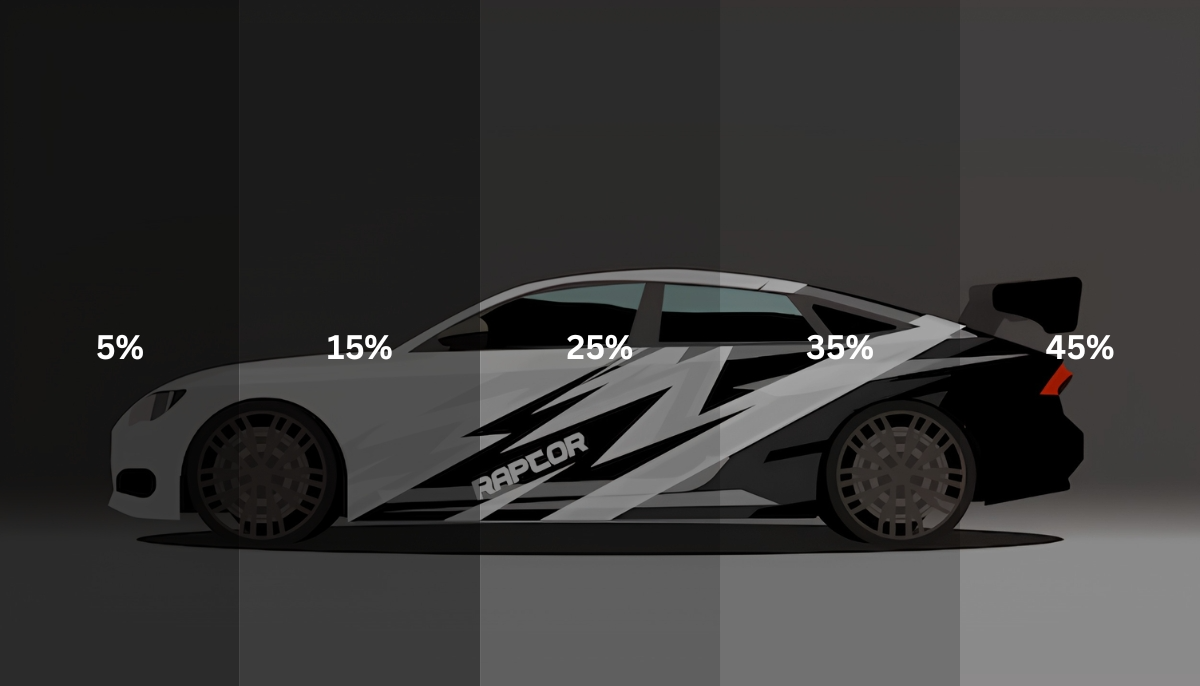
Many Texas drivers receive tint violations simply because they did not understand what the law actually allows. This article covers the complete Texas window tint law for 2026, addressing legal VLT percentages by window type, medical exemptions, penalties, and annual inspection requirements. All information is drawn directly from the Texas Department of Public Safety and the Texas Administrative Code, the two governing sources for all Texas tint standards.
What Is VLT and How Texas Measures Legal Tint
VLT is the abbreviation for Visible Light Transmission, the standard measurement used in all Texas window tint regulations. It represents the percentage of visible light that passes through both the glass and the applied film combined. A higher VLT number means a lighter window, and a lower number means a darker window. Texas law sets minimum VLT thresholds for each window position on a vehicle. Those thresholds apply to the combined reading of factory glass plus any aftermarket film installed.
How Factory Glass Changes the Legal Equation
Many drivers install tint film rated at 25 percent VLT and assume the installation is fully legal. This assumption is incorrect when the vehicle’s factory glass already reduces light transmission before the film is applied. If factory glass transmits only 80 percent of visible light and a 25 percent VLT film is added on top, the combined transmittance drops well below the legal threshold. Drivers should ask their installer to measure the combined VLT of both glass and film together before finalizing any tint installation.
The combined VLT issue is one of the most common reasons drivers fail the annual vehicle inspection after paying for a professional installation. A qualified installer will use a VLT meter on the actual glass before recommending a film darkness level for that specific vehicle. Popular Texas vehicles including the Ford F-150, Toyota Camry, and Chevy Silverado often ship from the factory with glass that already reduces visible light by 10 to 20 percent. Understanding this before installation prevents costly reinspection fees and citations.
Texas Window Tint Law by Window Position
The Texas DPS Window Tinting Standards page provides the official specifications that all registered Texas vehicles must meet. The rules differ significantly depending on which window is being tinted. Front side windows are subject to the strictest limits, while rear side windows and the rear windshield allow much darker tint for most vehicle types. Each window position carries its own VLT minimum and reflectivity ceiling under the Texas Administrative Code.
Front Side Windows
Front side windows on all vehicle types must allow more than 25 percent of visible light to pass through. This is the legal minimum for the driver side and front passenger side windows when measured as a combined reading of glass and film. Tint that allows only 24 percent VLT is technically illegal under Texas law even though the visual difference is minimal to the naked eye. Law enforcement officers use calibrated VLT meters during traffic stops to measure front window compliance, and a single percentage below the limit is sufficient grounds for a citation.
Rear Side Windows
Rear side windows behind the driver seat are treated very differently under Texas window tint law. Both passenger vehicles and multi-purpose vehicles including SUVs, vans, and pickup trucks may have any level of darkness on rear side windows. A 5 percent VLT limo tint is fully legal on rear side windows regardless of vehicle classification. The only requirement for legally using darker tint on rear windows is that the vehicle must be equipped with two functional outside rearview mirrors, one on each side of the vehicle.
Rear Windshield
The rear windshield follows the same permissive rule as rear side windows for most vehicle types. Any tint darkness level is permitted on the rear windshield as long as the driver maintains dual outside rearview mirrors in proper working condition. Many Texas drivers choose to match the rear windshield darkness to their rear side windows for a uniform appearance across the back of the vehicle. This is fully legal and does not require a medical exemption or any special documentation from the Texas DPS.
Windshield Tinting Rules and the AS-1 Line
The front windshield carries the strictest tinting restrictions under Texas window tint law. Tint film may only be applied above the manufacturer’s AS-1 line, which is the marking on the windshield set by the glass manufacturer and is typically located within the top five inches of the glass. Any film applied in that windshield visor strip must have a VLT of 25 percent or greater and a luminous reflectance of no more than 25 percent. Clear UV protective film is permitted across the entire front windshield as long as it does not visibly alter the glass color or reduce light transmission.
Reflectivity Rules and Restricted Tint Colors
Texas law does not only regulate tint darkness. It also establishes firm limits on how reflective a tint film can be when installed on a vehicle. Front side windows and rear side windows must not exceed 25 percent luminous reflectance. Films with a metallic or mirrored finish that reflect more than 25 percent of incoming light are prohibited even when the VLT percentage falls within the legal range. Reflectivity is measured during annual vehicle inspections and enforced alongside VLT as part of the same compliance check.
Certain tint colors are prohibited entirely under Texas law regardless of their VLT or reflectivity rating. Red, amber, and blue tints are not permitted on any window of any vehicle registered in Texas. These colors are restricted because they can interfere with a driver’s ability to distinguish traffic control signals and emergency vehicle lights. Any installer offering red, amber, or blue tint films for window application in Texas is operating in violation of the Texas Transportation Code.
Texas Window Tint Law for Sedans vs SUVs and Trucks
Texas window tint law applies specific rules based on federal vehicle classification. Passenger vehicles, which typically include standard sedans, must have front side windows at 25 percent VLT or higher when the combined glass and film reading is taken. Multi-purpose vehicles, a federal classification that covers most SUVs, pickup trucks, and vans, are subject to that same 25 percent VLT front window requirement. The meaningful distinction between vehicle types applies primarily to rear windows, where both classifications are permitted any tint darkness when dual mirrors are present.
A widespread misconception among Texas drivers is that SUVs and trucks are allowed darker front window tint than sedans. Under current Texas law that distinction does not apply to front side windows. Both vehicle types must meet the 25 percent VLT minimum on the driver and front passenger windows. Drivers should verify their vehicle’s federal classification when in doubt, as some crossover vehicles may be classified differently than their physical appearance suggests.
Texas Window Tint Medical Exemption
Texas law allows drivers with certain medical conditions to apply tint darker than the standard legal limits permit. The Texas Administrative Code Rule 21.3 governing sunscreening devices outlines the full exemption framework. As of January 1, 2019, the Texas Department of Public Safety no longer issues official window tint exemption certificates. Drivers who qualify for an exemption must instead carry a signed written statement from a licensed physician or optometrist at all times while operating the vehicle on Texas roads.
Medical Conditions That May Qualify
Several medical conditions may qualify a Texas driver for a window tint exemption beyond the standard legal limits. Qualifying conditions include lupus, albinism, solar urticaria, vitiligo, Bloom syndrome, erythropoietic protoporphyria, and Cockayne syndrome. Other autoimmune or genetic diseases causing severe sensitivity to sunlight or visible light may also qualify based on a physician’s assessment. Skin cancer patients and individuals undergoing treatments that increase photosensitivity may be eligible. The attending physician or licensed optometrist determines eligibility and documents the medical necessity in a signed written statement.
How the Exemption Process Works After 2019
Since the Texas DPS no longer issues exemption certificates, the driver must obtain a signed statement directly from a licensed physician or licensed optometrist. That statement must identify the specific medical condition and confirm that window tint beyond the standard legal limit is medically necessary for that individual. The driver must keep the original signed statement inside the vehicle at all times when operating on public roads. During a traffic stop or at an annual inspection, presenting that document to the officer or inspector is required to avoid a violation being issued.
Certification Stickers and Film Manufacturer Requirements
Texas law requires that tint film sold and installed in the state be certified by the manufacturer before it can be legally applied to a vehicle. Certified film comes with documentation confirming that it meets all applicable Texas tint standards for VLT and reflectivity. After installation, a compliance sticker identifying the legal tinting must be placed between the film and the glass on the driver side window. This sticker serves as on the spot evidence during traffic stops and state inspections that the installed film meets state requirements.
Drivers should always verify that their chosen tint installer uses certified film before agreeing to any installation. An installer who applies uncertified film places the vehicle owner at legal risk for every subsequent traffic stop and inspection. The manufacturer certification requirement means that not all films available online or through aftermarket retail channels are legal for use on Texas roads. Requesting the manufacturer’s certification documentation before approving any installation is a straightforward step that protects the driver from future liability.
Texas Window Tint Penalties and Fines
Violating Texas window tint law is a Class C misdemeanor under Texas Transportation Code Section 547.613. Penalties apply to both vehicle operators driving with non-compliant tint and to installers or sellers who knowingly apply or supply non-compliant film. The range of consequences differs based on whether the violation is a first offense, a subsequent offense, or a commercial violation involving an installer or seller.
First Offense and Fix-It Tickets
First time tint violations in Texas typically result in a fine ranging from $20 to $275 depending on the county and the citing officer’s discretion. Court costs can add an additional $50 to $150 on top of the base fine. In many cases, a first time offender receives a fix-it ticket, which allows the driver to correct the violation within a set timeframe and have the citation dismissed without the full fine imposed. To resolve a fix-it ticket, the driver must remove the illegal tint and provide documented proof of correction to the citing agency.
Repeat Offenses and Installer Liability
Subsequent tint violations carry higher fines and significantly less likelihood of receiving a dismissable fix-it ticket. Repeat offenders may face the maximum fine along with mandatory court appearances. Tint film installers and sellers face separate liability under Texas Transportation Code Section 547.613. Those who knowingly install or sell non-compliant tint can face misdemeanor penalties of up to $1,000 per violation. Sellers are not liable for fines incurred by buyers who independently apply illegal tint after purchase, provided the sale itself was conducted lawfully.
How Police Check Window Tint in Texas
Texas law enforcement officers use calibrated VLT meters to measure tint compliance during traffic stops. The officer places the meter against the glass of the suspect window and takes a reading in seconds. That reading reflects the combined VLT of the factory glass and any applied film. If the reading falls below the legal threshold for that window position, the officer may issue a citation or a fix-it ticket based on that objective measurement. The reading can be used as evidence in court to support the violation.
County-level enforcement of tint laws varies considerably across the state. Border counties in South Texas including Hidalgo County are known for enforcing tint laws more strictly than many interior Texas counties. Harris County and Dallas County both report active tint enforcement as part of standard traffic stop procedures. Drivers who travel across multiple Texas counties should understand that enforcement intensity is not uniform statewide, and a tint level that goes unnoticed in one area may result in a citation and court costs in another.
Ceramic Tint and Heat Rejection in the Texas Climate
Ceramic tint has grown substantially in popularity across Texas due to the state’s extreme summer heat conditions. Modern nano-ceramic tint films can block up to 96 percent of infrared heat and up to 99 percent of UV rays while maintaining a VLT percentage that stays within Texas legal requirements. These films achieve superior heat rejection without requiring extremely dark visible tint, making them well suited for drivers who want maximum heat and UV protection while remaining fully compliant with state law.
The wider adoption of ceramic films has introduced a specific compliance risk on windshields. Some installers apply ceramic film across the entire front windshield to maximize UV blocking, but if any portion of that film extends below the AS-1 line the installation becomes a legal violation even if the film is visually clear. Officers and inspectors checking windshield compliance focus on film placement and not only on VLT rating. Drivers requesting full windshield ceramic film must confirm with their installer that placement remains strictly above the manufacturer’s AS-1 line.
Tesla and Modern Vehicles With Factory Privacy Glass
Tesla vehicles and other modern cars with factory privacy glass present a specific tint compliance challenge under Texas law. Many Tesla models leave the factory with glass that already carries a significant VLT reduction built into the manufacturing process. Adding aftermarket tint on top of factory privacy glass on rear side windows or the rear windshield is legal as long as dual outside mirrors are present and functional. However, adding any aftermarket film to a Tesla front side window requires careful combined VLT measurement to confirm the total reading still meets the 25 percent legal minimum.
Annual Vehicle Inspection and Tint Compliance
Every Texas vehicle must pass an annual state inspection, and window tint is a standard item on the inspection checklist. An inspector who finds front side window VLT below 25 percent, prohibited windshield tint below the AS-1 line, reflective film exceeding 25 percent, or a missing compliance sticker will fail the vehicle on that inspection. A failed inspection prevents registration renewal in Texas. Correcting a tint violation and returning for a new passing inspection is required before the vehicle’s registration can be processed by the Texas DMV.
Drivers who fail inspection due to non-compliant tint must remove the illegal film, restore the window to clear glass or a legal tint level, and return for a new inspection at their own cost. The combined expense of film removal, reinstallation of compliant film, and multiple inspection fees can far exceed the original savings of choosing a cheaper illegal tint option. Selecting certified film within the legal VLT range during the initial installation eliminates this expense and legal exposure entirely.
Conclusion
Texas window tint law establishes a 25 percent VLT minimum for front side windows on all vehicle types and permits any tint darkness on rear side windows and rear windshields when dual outside mirrors are present. The windshield may only be tinted above the AS-1 line at 25 percent VLT or greater. Red, amber, and blue tint colors are prohibited statewide. Reflectivity must not exceed 25 percent on any window. Certified film and a compliance sticker on the driver side window are required by law for all legal tint installations in Texas.
Medical exemptions remain available for drivers with qualifying conditions including lupus, albinism, solar urticaria, vitiligo, and other light sensitivity diseases. Since January 1, 2019, those exemptions are documented through a signed physician or optometrist statement rather than a state-issued certificate. First time violations result in fines from $20 to $275 plus court costs, with fix-it tickets often available for correctable offenses. Installers who knowingly apply illegal tint face penalties of up to $1,000 under Texas Transportation Code Section 547.613.
Drivers planning a tint installation should have their factory glass measured first, select certified film from a qualified installer, and confirm the final combined VLT reading before leaving the shop. Tint regulations vary considerably from state to state, and drivers who travel frequently or relocate should review the rules that apply to their situation. Drivers in neighboring states or those moving across state lines can start by reviewing the florida window tint law as a clear example of how tint regulations differ beyond Texas borders.