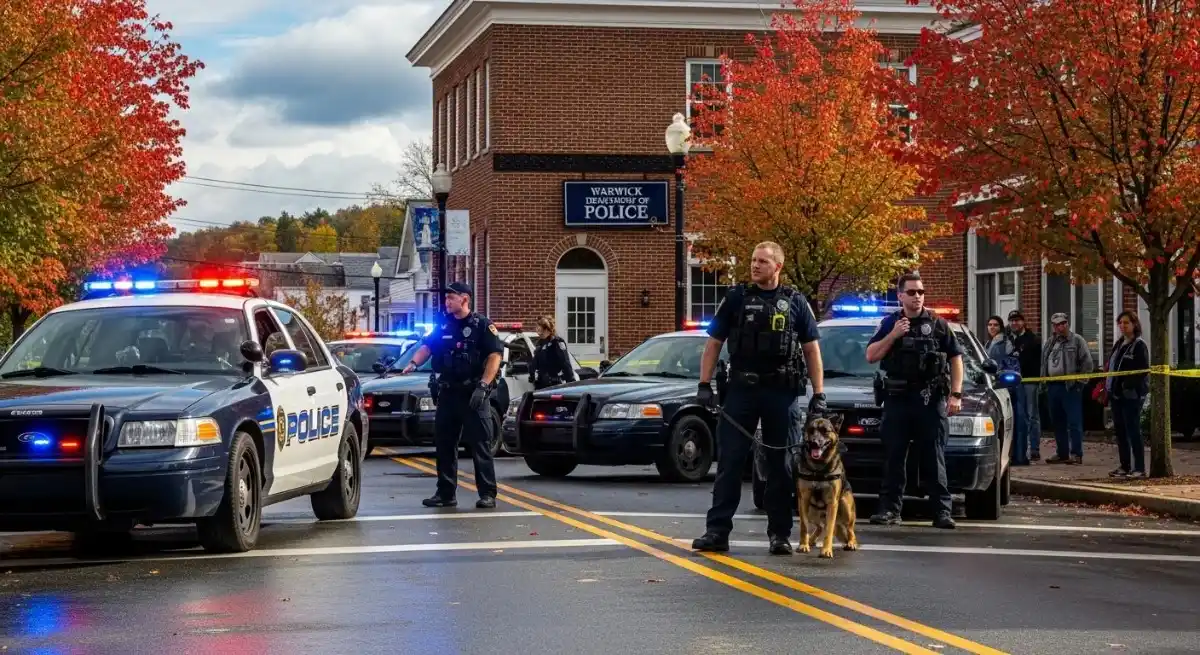
A law enforcement operation warwick ny involves coordinated police activity by multiple agencies to investigate crimes, execute warrants, or conduct surveillance operations affecting residents and businesses. These operations often include road closures and heightened police presence across specific neighborhoods or commercial districts in the community. Understanding your constitutional rights during these operations empowers you to navigate interactions confidently while law enforcement personnel conduct their investigative work. At Lawwalls, we provide comprehensive legal guidance to help Warwick residents recognize legitimate operations and protect their civil liberties during multi-agency police activity throughout Orange County and surrounding jurisdictions.


Lawwalls
Get realtime updates and indepth insights? Follow our WhatsApp channel to receive instant notifications and stay informed.
FollowWhat Is a Law Enforcement Operation Legal Definition and Types
Law enforcement operations represent structured police activities where one or more agencies coordinate resources to accomplish specific investigative objectives within defined geographic boundaries. These operations range from simple warrant executions lasting several hours to complex multi-day investigations involving tactical teams and specialized surveillance equipment. Criminal investigation procedures typically include search warrant service, evidence collection activities, suspect apprehension efforts, and witness interview coordination across various locations simultaneously. Public safety operations in Warwick often involve the Town of Warwick Police Department working alongside state and federal partners to address drug trafficking, cold case investigations, or organized criminal activity requiring enhanced resources beyond local capacity.
Tactical operations law enforcement teams conduct involve heightened security measures including perimeter establishment, road closure implementation, and traffic pattern modifications to protect officers and civilians during active investigations. Investigative operations may include undercover surveillance, controlled buys, electronic monitoring, or coordinated arrests targeting multiple suspects across different properties simultaneously. The complexity of modern criminal enterprises often necessitates interagency law enforcement cooperation bringing together local police, state troopers, federal agents, and specialized task forces with complementary expertise and jurisdictional authority to effectively investigate and prosecute sophisticated criminal networks operating throughout the region.
Agencies Involved in Warwick NY Law Enforcement Operations
The Town of Warwick Police Department serves as the primary law enforcement agency handling daily public safety operations and routine criminal investigations within municipal boundaries. New York State Police Troop F maintains barracks in Middletown and regularly assists with major incidents, highway patrol functions, and specialized investigative services requiring state-level resources or expertise. Orange County Sheriff deputies provide court security, warrant service, and supplemental patrol support while the Orange County District Attorney David Hoovler oversees prosecutorial coordination for multi-jurisdictional cases requiring enhanced legal resources. Federal agencies including the FBI, DEA, and ATF participate when investigations involve interstate criminal activity, federal statute violations, or organized crime enterprises operating across multiple states.
Multi-agency task forces combine personnel and equipment from various departments to address specific crime categories like narcotics trafficking, human trafficking, or cybercrime investigations affecting communities throughout Orange County. These collaborative efforts pool specialized training, technical capabilities, and investigative experience that individual departments might lack independently while sharing operational costs and legal responsibilities. Police jurisdiction authority determines which agency leads specific operations based on crime location, statute violated, and resource availability while maintaining clear command structures preventing conflicting directives or operational confusion. Neighboring communities including Greenwood Lake, Pine Island, and Florida NY often coordinate with Warwick officers for investigations crossing municipal borders or affecting multiple jurisdictions simultaneously.
Your Constitutional Rights During a Law Enforcement Operation
Fourth Amendment protections shield citizens from unreasonable searches and seizures by requiring law enforcement to obtain judicial warrants before entering private property or seizing personal belongings. Constitutional rights during police activity remain fully enforceable even during large-scale operations involving multiple agencies or high-priority investigations targeting serious criminal offenses. You possess the absolute right to remain silent when questioned by officers and cannot face legal penalties for declining to answer questions without legal counsel present. Police powers limitations prevent officers from detaining you indefinitely without probable cause or arresting you without sufficient evidence establishing reasonable belief you committed specific criminal violations.
Due process rights guarantee fair treatment throughout any interaction with law enforcement including proper notification of charges, access to legal representation, and timely judicial review of detention decisions. Officers cannot coerce confessions through threats, physical intimidation, or misleading statements about evidence strength or potential consequences you face if refusing cooperation. Search and seizure laws require police to describe with particularity the places to be searched and items to be seized when obtaining warrant authorization from judges. You maintain the right to witness any search of your property, document the process, and ensure officers remain within the scope of warrant terms without exceeding authorized boundaries or timeframes.
Civil liberties protections prevent discriminatory enforcement based on race, religion, national origin, or other protected characteristics while ensuring equal treatment under law regardless of socioeconomic status. Reasonable suspicion standards govern brief investigative stops requiring officers to articulate specific facts suggesting criminal activity before detaining individuals for questioning. Probable cause requirements establish higher evidentiary thresholds for arrests and searches demanding sufficient evidence convincing reasonable persons that crimes occurred and specific suspects committed those offenses.
Understanding No Danger to the Public and Other Police Notifications
Police departments issue community notification protocols to inform residents about ongoing operations while managing public concern and preventing interference with sensitive investigative activities. The phrase no danger to the public indicates operations pose no immediate threat to uninvolved community members and typically involve targeted investigations against specific suspects rather than random criminal activity affecting general populations. Law enforcement transparency obligations require agencies to provide reasonable information about operation nature, expected duration, and affected geographic areas without compromising investigative integrity or officer safety. Emergency response procedures distinguish between situations requiring civilian evacuation and those permitting residents to shelter in place while maintaining normal activities.
Media advisory systems utilize press releases, social media platforms, and direct notifications to journalists covering law enforcement activities and public safety issues throughout Orange County. Officers cannot legally compel you to leave your residence during operations unless legitimate safety concerns exist such as explosive devices, chemical hazards, or active shooter situations endangering nearby occupants. Community policing standards emphasize maintaining positive relationships with residents through transparent communication, respectful interactions, and accountability for officer conduct during both routine patrols and major operations. Police departments typically update communities through official websites, social media channels, and local news media as operations conclude or circumstances change affecting public safety recommendations.
Road Closures and Access Restrictions What the Law Allows
Law enforcement possesses statutory authority to temporarily close roads and restrict access to specific areas when public safety concerns or operational security necessitate traffic control measures. Officers can implement road closures without advance public notification when urgent circumstances prevent prior announcement while maintaining responsibility to establish alternate routes and minimize disruption to residents and businesses. Police executive authority over traffic management during operations stems from emergency powers granted by state statutes and local ordinances empowering officers to control vehicle and pedestrian movement ensuring civilian safety and investigation effectiveness. Reasonable duration for road closures varies based on operation complexity with simple warrant executions typically concluding within several hours while extensive crime scene processing or evidence collection may require extended restrictions lasting multiple days.
Residents living within closed perimeters generally maintain access rights to their properties though officers may require identification verification and implement safety protocols before permitting entry through secured boundaries. Emergency vehicle access remains prioritized during all operations with fire departments and ambulance services coordinating with police commanders to maintain response capabilities throughout affected neighborhoods. Police department policies typically require supervisory approval for closures exceeding specific timeframes while mandating periodic reassessment of continued necessity as investigations progress and security concerns diminish. Traffic pattern modifications may include detours, one-way restrictions, or complete street closures depending on operational requirements and available alternate routes accommodating diverted vehicle flow.
Business owners affected by access restrictions may request special accommodations for customer access, deliveries, or employee parking though such requests undergo security screening before approval. Officer conduct standards require courteous professional interactions with inconvenienced residents while explaining closure necessity and providing realistic timeframe estimates for restriction removal. Law enforcement best practices emphasize minimizing community disruption through strategic perimeter placement, efficient evidence processing, and prompt restoration of normal traffic patterns when investigative objectives conclude.
Multi-Agency Operations How Jurisdiction and Authority Work
Police jurisdiction authority determines which agency possesses legal power to investigate crimes, make arrests, and enforce specific statutes within defined geographic boundaries or subject matter areas. Federal law enforcement agencies exercise nationwide jurisdiction for violations of United States Code provisions while state police enforce New York Penal Law throughout the entire state including Warwick and surrounding communities. Local police departments maintain primary authority within municipal limits though they can request assistance from county, state, or federal partners when investigations exceed available resources or involve crimes crossing jurisdictional boundaries.
Interagency cooperation agreements establish protocols for sharing information, coordinating investigations, and determining lead agency responsibilities when multiple departments possess concurrent jurisdiction over criminal matters. Task force operations typically designate a command structure identifying which agency supervisor makes tactical decisions, allocates resources, and coordinates participant actions during joint operations involving personnel from various departments. Legal authority for arrests and evidence seizures derives from the individual officer’s employing agency regardless of task force participation meaning state troopers apply state law while federal agents enforce federal statutes during combined operations.
Cross-designation programs allow local officers to receive temporary federal authority or state police to obtain local enforcement powers facilitating seamless multi-jurisdictional investigations without technical legal complications. Prosecutorial decisions consider which jurisdiction offers strongest charges, most favorable venue, or greatest penalties when multiple prosecutors could potentially file cases based on single criminal conduct. Resource sharing arrangements permit agencies to pool specialized equipment, trained personnel, and financial costs making sophisticated investigations feasible for smaller departments lacking independent capabilities for complex operations.
Can You Record or Observe Law Enforcement Operations
New York law permits citizens to photograph and video record police officers performing duties in public spaces provided recording activities do not physically interfere with legitimate law enforcement functions. You possess constitutional rights to document police operations from safe distances outside secured perimeters without facing arrest for simply observing and recording visible activities. Officers cannot lawfully demand you stop recording, seize your devices, or delete footage without valid warrants or exigent circumstances justifying such actions under established legal precedents. Recording police conduct serves important accountability functions while creating potential evidence useful in complaint proceedings or litigation involving alleged officer misconduct during operations.
Safe distance requirements prevent civilians from approaching active arrest scenes, tactical operations, or evidence collection areas where physical presence might compromise officer safety or investigative integrity. Police can establish perimeter boundaries using barrier tape, vehicles, or verbal commands requiring observers and media representatives to maintain specified distances from active operation zones. Interference definitions typically include physical obstruction of officers, loud verbal disturbances disrupting communications, or refusal to comply with lawful orders to move from dangerous or restricted locations. You cannot enter private property without owner permission to record operations occurring on residential or commercial premises even if police activity remains visible from public vantage points.
Evidence preservation through citizen recordings has proven valuable in investigations of officer conduct, use of force incidents, and complaint resolution processes providing objective documentation of contested events. Best practices for recording include maintaining respectful distances, avoiding verbal confrontations with officers, clearly identifying yourself as observer rather than participant, and preserving original footage without editing or alteration. Officer conduct standards prohibit retaliatory arrests, equipment seizures, or intimidation tactics against citizens lawfully exercising recording rights during police operations absent legitimate legal justifications.
When Can Police Enter Your Property During an Operation
Warrant requirements new york demand law enforcement obtain judicial authorization before entering private property to search for evidence or apprehend suspects except when specific exceptions justify warrantless entry. Fourth Amendment protections establish strong presumptions favoring warrant procurement through neutral magistrate review of probable cause affidavits before police intrude upon reasonable privacy expectations in homes and curtilage areas. Exigent circumstances exceptions permit warrantless entry when emergency situations create urgent needs preventing practical warrant acquisition such as preventing imminent evidence destruction, pursuing fleeing felons, or responding to serious threats against persons inside premises.
Knock and announce rules require officers executing search warrants to identify themselves, state their purpose, and provide reasonable time for occupants to respond before forcing entry absent circumstances justifying no-knock authorization. Consent searches occur when property owners or persons with apparent authority voluntarily permit police entry without warrants though consent can be withdrawn at any time during searches. Hot pursuit doctrine allows officers chasing suspects who commit crimes in their presence to follow fleeing individuals across property boundaries and jurisdictional lines without obtaining warrants before entry.
Plain view seizures permit officers to confiscate contraband or evidence visible from lawful vantage points without additional warrant requirements provided initial presence was legally justified. Curtilage protections extend Fourth Amendment coverage to areas immediately surrounding homes including porches, yards, and outbuildings where residents maintain reasonable privacy expectations. Police cannot create exigent circumstances through their own conduct such as banging loudly on doors to provoke evidence destruction then claiming emergency justifications for warrantless entry.
Property Damage During Law Enforcement Operations Your Legal Options
Municipal liability standards require government agencies to compensate property owners for damages caused by police operations when officer conduct exceeds necessary force or scope required for legitimate law enforcement purposes. New York General Municipal Law Section 50-e establishes notice of claim requirements mandating written damage notifications to responsible agencies within ninety days after incidents occur or legal claims become permanently barred. Documentation procedures should include detailed photographs of all damage, written descriptions of losses, repair estimates from licensed contractors, and witness statements corroborating damage circumstances and extent.
Compensation recovery processes begin with filing formal claims identifying responsible agencies, describing property damage specifics, estimating monetary losses, and explaining legal theories supporting liability allegations. Government agencies typically conduct investigations evaluating claim validity, assessing damage causation, and determining whether sovereign immunity protections or other defenses apply before settlement negotiations begin. Court litigation becomes necessary when agencies deny claims, offer inadequate settlements, or miss statutory response deadlines requiring judicial intervention to resolve compensation disputes through trial proceedings.
Qualified immunity doctrines protect individual officers from personal liability for damages unless their conduct violated clearly established constitutional rights that reasonable officers would recognize under similar circumstances. Evidence preservation requires maintaining damaged property in existing condition when practical, retaining all repair receipts and documentation, and avoiding repairs that might eliminate proof of original damage extent. Property owners should separate emergency repairs preventing further damage from non-urgent restoration work while documenting necessity for immediate action preventing additional losses.
How to Verify a Legitimate Law Enforcement Operation
Verification procedures include calling Warwick Police Department non-emergency lines at 845-986-5000 or New York State Police Troop F to confirm operation legitimacy and obtain basic information about activities occurring in your neighborhood. Official media advisories appear on department websites, verified social media accounts, and through local news outlets covering significant law enforcement operations affecting community members. Unmarked vehicles used during operations typically display concealed emergency lights, official government license plates, and equipment consistent with legitimate law enforcement purposes rather than civilian modifications.
Plainclothes officers should display badges and identification upon request while explaining their agency affiliation and operation purpose within limits that do not compromise investigative security or officer safety. Red flags indicating potential scams include demands for immediate cash payments, threats of arrest without proper documentation, reluctance to provide badge numbers or official identification, or operations occurring at unusual hours without clear legitimate purposes. Command post locations often include marked police vehicles, uniformed supervisors, and official signage identifying the operation presence and contact information for public inquiries.
Emergency contact protocols encourage residents to call 911 if uncertain about operation legitimacy or if situations appear threatening or inconsistent with normal law enforcement procedures. Verification helps protect communities from criminals impersonating officers to gain property access, commit thefts, or perpetrate other crimes under false authority pretenses. Legitimate operations typically involve multiple officers, marked vehicles, official documentation, and coordination with local departments even when federal agencies lead investigations.
Filing Complaints and Seeking Accountability
Internal affairs divisions within police departments investigate allegations of officer misconduct, excessive force, unprofessional behavior, or violations of departmental policies and procedures. Civilian complaint review processes provide independent oversight mechanisms allowing community members to report concerns about police conduct during operations without relying solely on department self-investigation. Orange County District Attorney David Hoovler maintains authority to investigate certain complaints involving potential criminal conduct by law enforcement personnel during operations.
New York Attorney General Civil Rights Bureau handles complaints involving serious civil rights violations, pattern and practice concerns, or situations where local agencies face conflicts of interest preventing impartial investigations. Complaint filing procedures typically require written statements describing incidents, identifying involved officers when possible, listing witnesses, and providing supporting documentation including photographs, videos, or medical records. Misconduct definitions encompass excessive force applications, false arrest or imprisonment, discriminatory enforcement, illegal searches or seizures, perjury, evidence tampering, and violations of constitutional rights during police encounters.
Evidence requirements include specific facts supporting allegations rather than general complaints about officer attitudes or investigation outcomes you disagree with absent procedural violations. Follow-up rights allow complainants to receive investigation status updates, findings notifications, and information about disciplinary actions taken though personnel privacy laws may limit detailed disclosure of officer punishment specifics. Complaint timelines vary by agency and violation severity with serious misconduct investigations potentially continuing for months requiring patience while thorough fact-finding proceeds.
Conclusion
Understanding your legal rights during law enforcement operations in Warwick empowers you to navigate these situations confidently while respecting officer safety and investigative needs. Constitutional protections remain enforceable regardless of operation size or participating agencies, and you maintain rights to remain silent, refuse warrantless searches, and document police activities from appropriate distances. Property damage claims require prompt action within ninety-day deadlines while complaint procedures offer accountability mechanisms when officer conduct raises legitimate concerns. At Lawwalls, we encourage Warwick residents to know their rights proactively, document interactions thoroughly, and seek legal counsel when questions arise about police conduct during operations affecting your property or civil liberties throughout Orange County communities.
If you want to learn about law internships for high school students, I have written a comprehensive guide covering paid and unpaid opportunities nationwide. The article explains age requirements, application strategies, what interns actually do, and alternatives if no programs exist near you. You will discover top programs in major cities plus virtual options for remote participants.
<?php


/**
 * Auto Table of Contents - WordPress Code Snippet
 * Shortcode: [auto_toc]
 * Headings: H2, H3, H4
 * Style: Grey Card (same as design)
 */

function auto_toc_shortcode() {
    global $post;
    if ( ! $post ) return '';

    $content = $post->post_content;

    // H2, H3, H4 extract karo
    preg_match_all( '/<h([234])[^>]*>(.*?)<\/h\1>/is', $content, $matches );

    if ( empty( $matches[0] ) ) return '';

    $items = '';
    $counter = 1;

    foreach ( $matches[2] as $index => $heading_text ) {
        $level     = $matches[1][ $index ];
        $clean     = wp_strip_all_tags( $heading_text );
        $anchor_id = 'toc-heading-' . $counter;

        // Indentation for H3, H4
        $indent = '';
        if ( $level == 3 ) {
            $indent = 'padding-left:16px;';
        } elseif ( $level == 4 ) {
            $indent = 'padding-left:32px;';
        }

        $items .= '<li style="' . $indent . '"><a href="#' . esc_attr( $anchor_id ) . '" style="color:inherit;text-decoration:none;">' . esc_html( $clean ) . '</a></li>';
        $counter++;
    }

    // TOC Card HTML + CSS + JS
    $html = '
<style>
.auto-toc-box{background-color:#F0F1F5;border:1px solid #D4D4D4;padding:16px 20px;border-radius:14px;font-family:\'Poppins\',-apple-system,BlinkMacSystemFont,\'Segoe UI\',sans-serif;width:100%;box-sizing:border-box;margin:20px 0;}
.auto-toc-row{display:flex;align-items:center;justify-content:space-between;gap:12px;}
.auto-toc-title{margin:0;font-size:1rem;font-weight:600;color:#000;flex:1;}
.auto-toc-btn{background:rgba(0,0,0,0.04);border:none;font-size:1.1rem;font-weight:600;cursor:pointer;width:32px;height:32px;border-radius:50%;display:inline-flex;align-items:center;justify-content:center;color:#000;font-family:inherit;}
.auto-toc-btn:hover{background:rgba(0,0,0,0.08);}
.auto-toc-body{display:none;margin-top:12px;padding-top:12px;border-top:1px dashed rgba(0,0,0,0.15);}
.auto-toc-body ol{margin:0;padding-left:20px;font-size:0.88rem;color:#111;line-height:2.1;font-family:inherit;}
.auto-toc-body ol li a:hover{text-decoration:underline;}
</style>

<div class="auto-toc-box">
  <div class="auto-toc-row">
    <h2 class="auto-toc-title">Table of Contents</h2>
    <button class="auto-toc-btn" onclick="(function(btn){var b=btn.closest(\'.auto-toc-box\').querySelector(\'.auto-toc-body\');var open=b.style.display===\'block\';b.style.display=open?\'none\':\'block\';btn.textContent=open?\'+\':\'×\';})(this)">+</button>
  </div>
  <div class="auto-toc-body">
    <ol>' . $items . '</ol>
  </div>
</div>';

    return $html;
}
add_shortcode( 'auto_toc', 'auto_toc_shortcode' );


/**
 * Article ki headings mein auto anchor IDs add karo
 * Taake TOC ke links kaam karein
 */
function auto_toc_add_anchors( $content ) {
    $counter = 1;
    $content = preg_replace_callback(
        '/<h([234])([^>]*)>(.*?)<\/h\1>/is',
        function( $matches ) use ( &$counter ) {
            $level   = $matches[1];
            $attrs   = $matches[2];
            $text    = $matches[3];
            $anchor  = 'toc-heading-' . $counter;
            $counter++;
            return '<h' . $level . $attrs . ' id="' . esc_attr( $anchor ) . '">' . $text . '</h' . $level . '>';
        },
        $content
    );
    return $content;
}
add_filter( 'the_content', 'auto_toc_add_anchors' );
Frequently Asked Questions About Law Enforcement Operations in Warwick NY
What does law enforcement operation mean in Warwick NY?
A law enforcement operation refers to coordinated police activity by one or more agencies to investigate crimes, execute warrants, or conduct surveillance, often involving road closures or heightened police presence.
Can police close roads in Warwick without advance notice?
Yes, police can close roads during active operations for public safety without advance notice, though they typically provide alternate routes and update residents through media advisories and local alerts.
What agencies conduct law enforcement operations in Warwick NY?
Warwick operations typically involve the Town of Warwick Police Department, New York State Police, Orange County District Attorney Office, Orange County Sheriff Office, and sometimes federal agencies like FBI.
Do I have to leave my home during a police operation?
No, unless officers specifically order evacuation for safety reasons. Police cannot force you to leave without lawful basis, though you should follow safety instructions given by on-scene personnel.
What does no danger to the public mean legally?
This phrase indicates the operation poses no immediate threat to residents not directly involved in investigation, meaning you can remain home but should avoid the active operation area.
Can I record law enforcement operations in New York?
Yes, New York allows recording police in public spaces from safe distances that do not interfere with operations, though you must not obstruct officers or enter secured perimeters.
What are my rights if police damage my property during operations?
You can file notice of claim with relevant agency within ninety days, documenting damages with photos and estimates, and potentially recover compensation through municipal liability or court proceedings.
How long can law enforcement operations last in residential areas?
Duration varies based on operation complexity. Simple warrant executions may last hours, while complex investigations like search operations or cold case work can extend over several days.
Can police enter my property during law enforcement operations?
Police generally need warrants to enter private property unless exigent circumstances exist like imminent danger, hot pursuit, or preventing evidence destruction, though they can approach your door.
How do I verify law enforcement operations are legitimate?
Call Warwick Police Department non-emergency line at 845-986-5000 or check official New York State Police social media and website for media advisories confirming operation legitimacy and location.
What is multi-agency task force operation?
It is when multiple law enforcement agencies including local, state, and federal coordinate resources and jurisdiction to investigate complex crimes requiring specialized expertise like drug trafficking or organized crime.
Can I file complaint about law enforcement operation?
Yes, complaints can be filed with the specific agency involved, Orange County District Attorney Office, or New York State Attorney General Civil Rights Bureau depending on concern nature.